
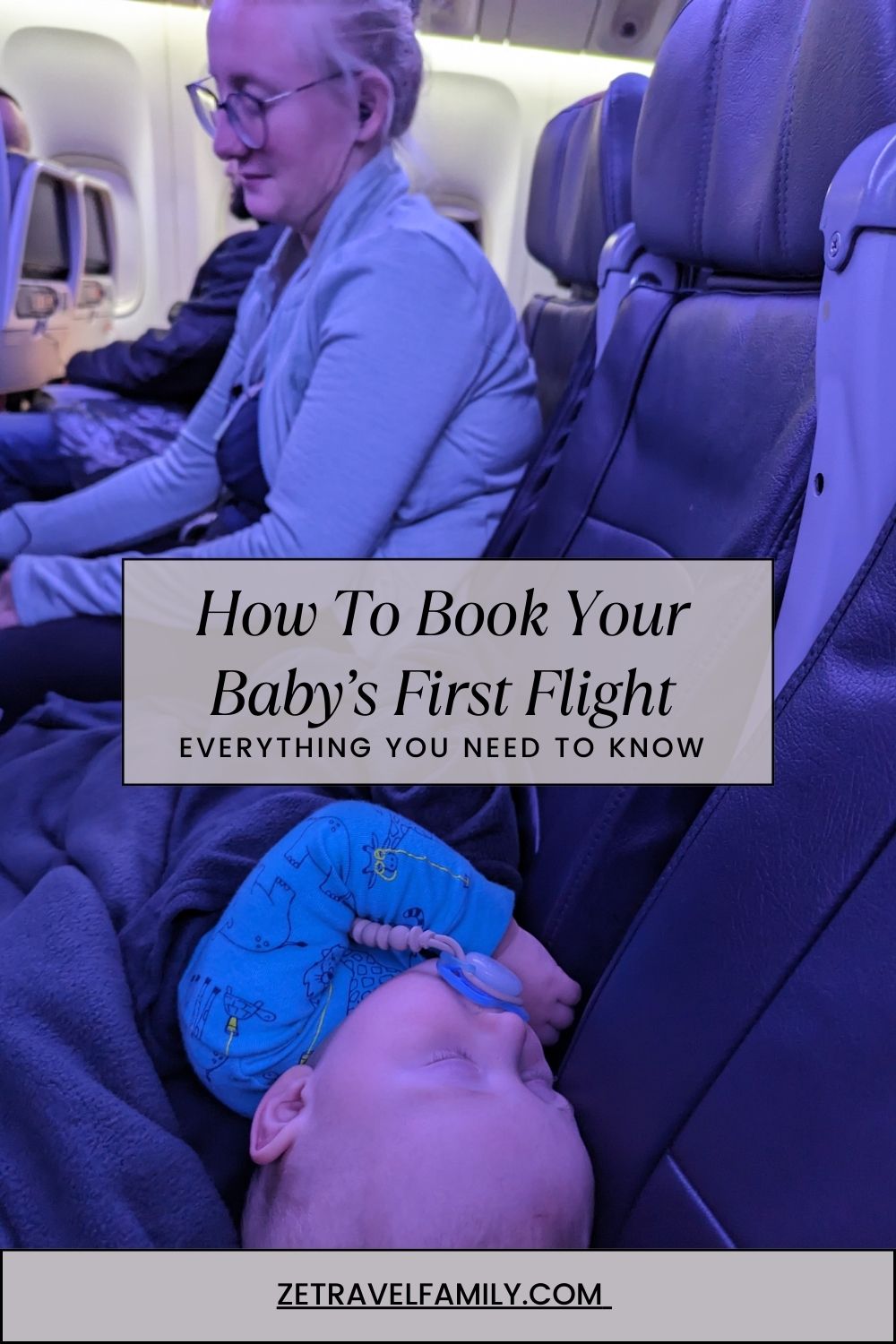
A baby’s first flight is exciting—and scary for their parents. Figruing out what you need to pack, when to get to the airport, and worrying about your baby the whole time can seem overwhelming.

Our first flight with the baby was when he was a whopping 5 weeks old. Since then, we’ve been on over 40 international flights as a family – and we’ve learned a lot along the way.
This article is part of a series aimed at parents worried about their baby’s first flight. It’s filled with helpful tips, tricks, and hacks we’ve learned through hard work and more than a few mistakes along the way.
Just to note: we fly international more than domestic. If you’re flying domestically, you don’t need as much paperwork for your baby.
Before Booking
Airlines require at least a birthdate, birth name, and gender of all infants traveling with you on your ticket. You can’t book your baby’s ticket while they are still in utero. Some airlines, like American, allow you to add a lap infant to an existing booking. Other airlines, like Bangkok Airways, make families wait until after the birth to complete the booking.
Do Your Research on the Destination
When we flew for the first time, we had a rock-solid “alibi”. We had to fly to Bangkok to apply for our baby’s passport. This alibi helped us dodge many anxious (yet well-meant) questions from our friends and family about our baby’s safety. Our next flight, to Chiang Mai, wasn’t as well recieved. Our friends and family couldn’t understand why we would willingly travel with a 3-month-old. In the end, our friends and family were correct. We flew to Chiang Mai to escape the sweltering heat of southern Thailand – and ended up in Chaing Mai during Burning Season!
This is a safe space. If you want to fly with your baby, I support you. Simply wanting to travel as a family is a good enough reason to travel together.
Picking the right destination is crucial.
Things I like to see in a destination are:
- Familiar climate (not going from tropical to arctic)
- Accessible health care, both physically and financially.
- Safety (not an active war zone, epicenter of a pandemic, etc.)
- Attractive (do you, as the parent, want to go there?)
Chat with your paediatrician or healthcare provider.
While flying with a newborn is safe, each child is different. Talk to your child’s doctor about your travel plans before booking a trip. This step is critical if your baby was born premature or has any underlying health conditions.

The mother’s recovery time is just as important. I had a C-section and was told to wait 4 weeks before traveling. I wasn’t able to lift a suitcase, sit for prolonged periods, or submerse myself in water for 6 weeks after giving birth. Luckily, my parents and husband flew with me to lighten my load.
Get Your Documents In Order
Before booking your trip, double and triple-check your travel documents.
If you’re traveling internationally, meaning anywhere outside your home country (or the country your child was born in), your entire family, including the baby, will need a valid passport.
For international trips, check everyone’s passports at least 3 months before departure. Your passport must be less than 10 years old and valid for at least 6 months after your return date.
If you live abroad, exist in a complicated legal situation, or are applying for a passport for the first time, don’t book your ticket without the passport. It took us three months to get our baby’s American Passport and over two years to get his German Passport.
If you’re traveling domestically, meaning not leaving your home country, bring a copy of your child’s birth certificate. We convinced the Thai Government to give us two birth certificates for our son. One is in a safety deposit box in Germany, and the other travels with us. If you’re an adoptive parent or had your baby via surrogacy, make sure to pack all valid adoption paperwork and custody agreements.
Read More: Check out this blog on the FAQ’s of Baby Safety while Flying.
Booking Your Travel
Once you’ve gathered your documents, checked with your child’s pediatirican and your OB/GYN, and metnally prepared yourself to share your plans with the world, it’s time to book your ticket.
We booked our baby’s first international flight 2 days before departure because we had to wait for his passport. This cost us a pretty penny – but less than cancelling our flights!
Booking the Ticket

Although booking directly through the airline is rarely the cheapest option, it’s worth the extra money in case of delays, lost luggage, or cancellations. It’s easier to add a lap infant, confirm a bassinet seat, add an infant meal to our ticket, and get compensated for any unexpected delays.
When flying internationally, you may notice the airline does not offer an infant booking option. Don’t worry, that’s completely normal. American Airlines, for example, only allows international infant bookings over the phone, never online.
Here are the options for seating available for your infant:
Lap Infant
Our baby has flown across the world as a lap infant. This means he flies for up to 10% of the price of our adult tickets, which is an incredible opportunity for cheap long-haul travel. It also means he has to spend the entire flight in one of our laps (it’s always Mommy’s lap).
We book lap infant tickets for several reasons.
- Price. It’s hard to willingly spend 90% more money on his ticket.
- Convenience. He hates the car seat and would spend the whole flight in my lap anyway.
- Price. Did I mention he flies for practically nothing?!
- Comfort. He sleeps longer when I hold him, and I prefer him asleep on long flights!
- Price. Guys. He flies to Europe for 10$.
Contrary to popular belief, lap infants are allowed to sit in the bassinet seats, if available, and are given a meal in addition to the parent’s. You might even luck out and score an empty seat on your flight. We’ve never purchased a seat for our baby, but on most long-haul flights, he gets his own.
How? Strategic booking. We book an aisle and window seat for his parents (or two aisles), leaving the middle seats free. Then, when checking in, we ask the gate agent if they can block the seat for us. Since we get to the airport well in advance, most of the time, we’re amongst the first to check in and we score the extra seat for free!
Independent Seat
If you’ve decided to book your child a seat, they must be in an FAA-approved car seat for takeoff, landing, and during turbulence. This rule applies to all infants, even those whose parents want to breastfeed them during takeoff, to help equalize their ears.
An FAA-approved car seat is the safest option for your little one in an emergency or unexpected turbulence. I’ve also heard from parents whose babies don’t turn into dragons when buckled in that their child is more comfortable in their car seat than on their parent’s lap. This is not the case for my dragon baby, so we don’t even attempt to bring our car seat on a plane.
Booking your child on their seat and flying in their car seat is the safest option for your baby. But it’s also the most expensive! You’ll be paying up to full price for their ticket.

Bassinet Seat
Parents on long-haul flights (typically above 5 hours) may be able to book their infant a bassinet seat. These seats are baby beds screwed into the wall of the plane and located towards the front of the aircraft.
To get bassinet seats, book your tickets and then call the airline’s customer service number. Be prepared to wait in a hold line for a while. I typically call directly after booking, as some airlines don’t allow passengers to purchase lap infant seats for international flights over the internet. Once you’ve gotten ahold of a booking agent, request the bassinet seat for your upcoming flight.
One thing to keep in mind – bassinet seats are the first row of economy, so you will not be able to raise your armrest, and you’ll have to stow your airline screen during takeoff and landing.





Leave a Reply