
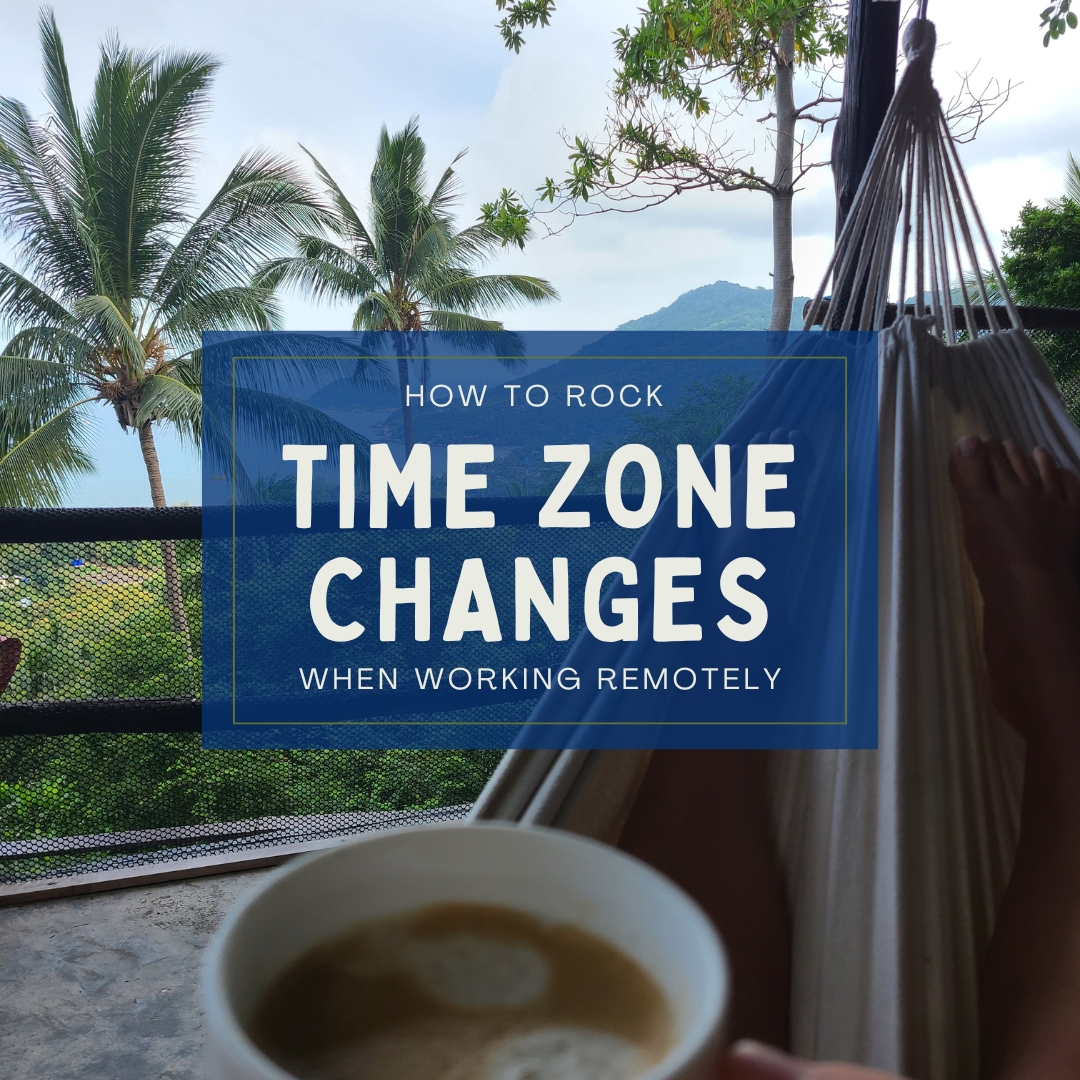
As digital nomads, we’ve gotten used to switching time zones frequently. Professionally, time zone changes are our most significant challenge. Remembering deadlines, logging on to meetings, and staying awake during 3 am calls is tough. Over the past three years, we’ve developed some solutions to help us juggle full-time travel, family life, and keep our jobs.

This blog post is not about dealing with jet lag. It’s about dealing with your colleagues, clients, and bosses when you’re hours behind (or ahead) of them.
For tips on dealing with jet-lagged babies, check out this blog post on surviving Jetlag with a Baby.
Make Yourself Valuable Even As A Digital Nomad
If you want your clients, boss, and coworkers to deal with your time zone changes, make sure you are worth it.
Deliver your projects on time (or early), deliver solid work, and work hard. Make yourself available outside of office hours, and go the extra mile. Especially in the early stages of your digital nomad life.

Make people understand your value before asking them to make an exception.
Check out this blog for tips on staying productive as a digital nomad.
Communicate Your Future Time Zone Clearly

Before booking the flight, discuss your upcoming time zone swap with your clients, coworkers, or bosses. Go into this conversation with an open mind. Be prepared to compromise on working times.
Make sure you discuss these questions with your boss and clients before take-off.
- What hours (outside of regular business hours) are you willing to work?
- How are you going to enforce boundaries?
- How strictly will your employer expect you to adhere to their working time?
- Can your colleagues change meeting times to accommodate you?
- Will moving to this time zone negatively impact your business?
- Are you expected to answer e-mails outside of your working hours?
Change Your Digital Time
If your company uses a program like Slack or Google Chat to communicate, ensure the time zone shown on your profile is correct.

By changing your time zone in an obvious way, you’re giving your colleagues a digital reminder about your local time.
I religiously update my Slack status, informing my colleagues about my lunch break, dinner break, and bedtime.
Giving your teammates the ability to understand where you are in your day prevents minor misunderstandings, like why you aren’t answering their e-mails directly.
Set Blockers In Your Calendar
To protect our sleep and preserve our work/life balance, we’ve always set blockers before 6 a.m. and after 10 p.m., no matter the time zone. Whenever we switch time zones, my husband blocks more time off than necessary, especially in the first weeks.
If it’s an urgent issue or essential meeting, his clients can reach him by telephone or e-mail and request a meeting outside of his usual availability. Most of the time, he complies.
The blockers help him filter out the catch-up meetings from the important ones directly related to his tasks. If it’s important enough to contact him directly, it’s important he makes the time for the meeting as well.
Be Mindful of Your Teammate’s Working Hours
We’ve worked ahead and behind of our colleagues, and it can be very frustrating to have to wait for everyone else to wake up to answer a simple question.
Once, I couldn’t log onto the server to update a list for work. I had no idea what I needed to log on to – I had a username, password, and VPN and was given access to the server. I had to wait six hours for my colleagues to wake up, drink their coffee, and start their work day before getting my answer. (I needed an additional program called Rubber Duck).
If you want your colleagues to respect your boundaries, you must respect theirs. Try to avoid sending e-mails shortly after you know they’ve logged off for the day, and learn to prioritize tasks and questions.
If you’re looking for a VPN to browse the international web, stream Australian Netflix (the best netflix), or work remotely without setting off any internal alarms, use NordVPN.
Be Flexible with Your Working Hours

When we began traveling, I had a daily meeting at 4:45 pm in Germany to chat with my boss.
My job depended on the tasks delegated to me during this meeting.
Our new time zone in Thailand moved this meeting to 9:45 pm for me.
Although I had communicated my upcoming time zone change clearly, made myself invaluable to the company, and put blockers in my calendar, the CTO of our company had a very inflexible schedule and was unable to find a different time for this meeting.
So, after getting ready for bed every evening, I turned my laptop back on and took the call.
If we’re in a time zone that lags behind German business hours, like in the Americas, our day tends to begin earlier. We’ll be up and out of bed by 5, allowing my husband to work until after the baby’s nap and giving us a free afternoon to spend as a family.
Travels in Southeast Asia mean we sleep in and maximize our mornings as family time before sending Papa off to work after lunch. Once the sun sets at 7 p.m., his work day slows down, and we spend the remaining hour enjoying dinner as a family before putting the baby to bed.
Embrace the Chaos
While planning your entire day around meetings doesn’t seem like the exotic digital nomad lifestyle you were promised, it is. We’ve met digital nomads who gave language classes and worked only in the evenings. These nomads missed out on parties, but they spent their entire day snorkeling, hiking, shopping, and having fun.
Sometimes, a meeting can’t be held at a reasonable hour for us. On those days, we set our alarms early (or late) and take the meeting at 3 am or 10 pm. We’ve found it easier to plan our entire day around a late or early meeting.


A digital nomad friend of ours moved from Germany to South-East Asia, putting her 5 hours ahead of her co-workers. When a colleague decided to try out the remote lifestyle, he moved to the Caribbean. The two of them were suddenly 11 hours out of sync.
Instead of complaining, the two of them found a compromise. My friend would be available from 6 to 9 pm, and this colleague from 7 to 10 am. This gave both of them a slot to communicate, and punished neither one of them.
The Truth About Working From Anywhere
Don’t believe everything you see on the internet. While digital nomadism is a great way to explore the world while working on your career and earning a steady wage, the truth about getting away from the 9 to 5 is that sometimes, it means working from 7 to 2 and 5 to 8.
Focusing on traveling in areas of the world that cost less than your home country will help you stretch your money further, allowing you to work fewer hours while traveling. We’ve been able to reduce our working hours from 80 (split between two people) to a mere 20 hours per week. This means fewer luxuries when traveling and it also means we aren’t saving any money, but it does mean spending quality time together as a family.
Working from anywhere can work, but only if your company is willing to work with you and you are willing to compromise with them. It’s unrealistic for you and your family to move somewhere that lies 12 hours ahead or behind your workplace – the time difference is too stark. We’ve found that around 5 hours time difference is the sweet spot. It allows you enough work hours with your colleagues to schedule meetings, have some focus time in the mornings or afternoons, and enjoy your life in your new surroundings.
For us, digital nomadism is about living different lifestyles. It’s about freedom and creating a life we enjoy living.





Leave a Reply